


Prepping Your Company Culture For Resilience When In The Midst Of Constant Change
Author: Julie Chance, Founder of Action-Strategies-By-Design

Over the last several months, we’ve looked at the characteristics and systems that help leaders stay resilient through continuous change. As we discussed in When Resilience Isn’t Enough, individual resilience only goes so far. This month, we’re exploring how culture can carry resilience across the entire organization and turn it into a competitive advantage.
What a Resilient Organization Looks Like
When I talk about a resilient organization, I mean one that adapts to changing conditions and recovers from setbacks without burning out its people. It can move through change and still perform at its best.
That last part is where many organizations fall short. A change can be delivered on time, hit its targets, and look like a success on paper. But if people come out of it exhausted or disengaged, the organization can’t capitalize on the next growth opportunity.
A colleague once shared his experience working on an announcement for a product touted as truly revolutionary. Instead of pushing innovation forward, the project turned into a demoralizing beat-down as specifications shifted and rollout dates were continuously pushed out. For nearly a year, the team was trapped in a monotonous cycle of endless rewrites, pulling them away from their core responsibilities and leaving them feeling unvalued and reduced to repetitive labor. When the announcement was finally released, a key team member resigned—having poured an entire year of energy into a single, exhausting release.
 That experience is far from rare. A Gartner survey found that 73% of HR leaders say their employees are fatigued from change. Change-fatigued employees are less inclined to stay, have lower trust in their employer, and give far less of the extra effort change depends on.
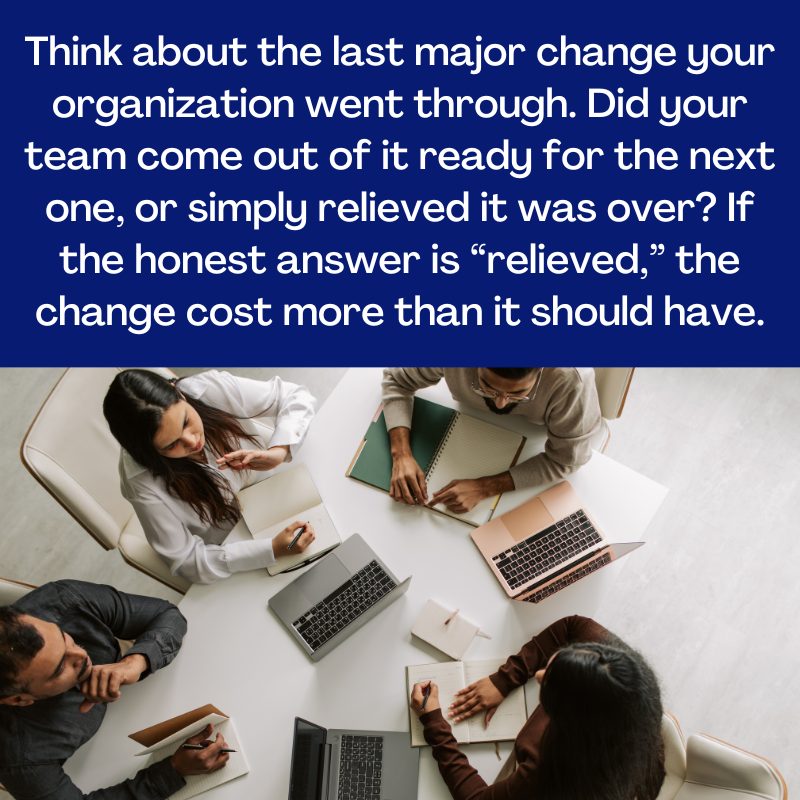
Think about the last major change your organization went through. Did your team come out of it ready for the next one, or simply relieved it was over? If the honest answer is “relieved,” the change cost more than it should have.
Resilient organizations break this cycle. Because their teams aren’t perpetually exhausted, they can test new service lines, enter new markets, or roll out product iterations while competitors are still recovering from the last round of disruption. That ability to act on opportunities others aren’t ready to pursue turns resilience from a survival skill into a growth strategy.
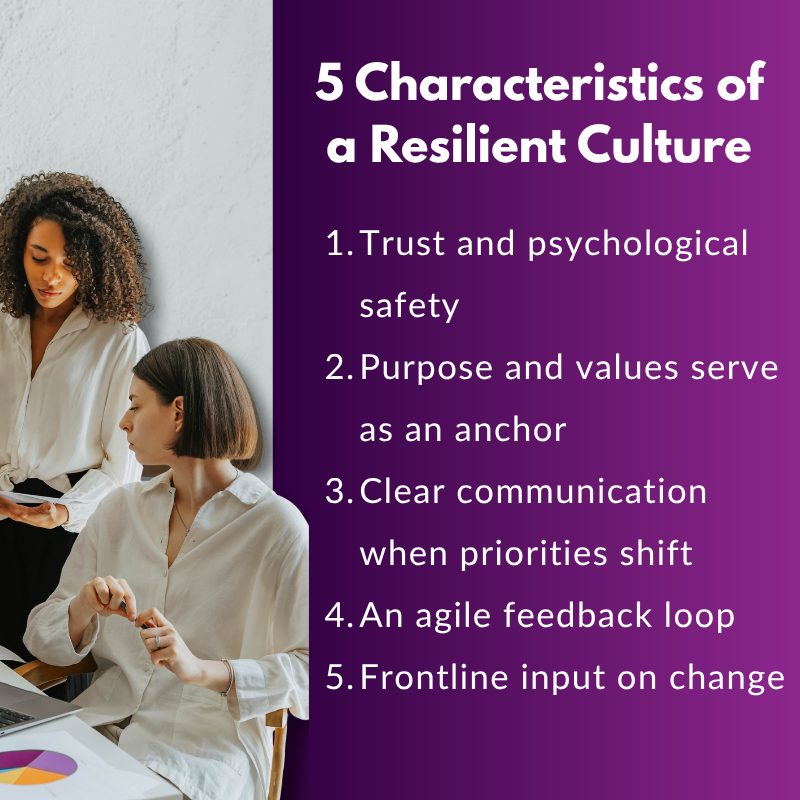
5 Characteristics of a Resilient Culture
The same traits show up again and again in organizations that handle change well. We’ve explored each of these five characteristics throughout our Mastering Change & Building Resilience series, so I’ll keep them brief.
- Trust and psychological safety. When trust is low, people spend their energy covering their actions and deflecting blame, leaving little for the work itself. By creating psychological safety, leaders make it safe for people to own their mistakes and recover faster from setbacks. Research group, Gartner, found that managers who do this can reduce change fatigue by up to 46%.
- Purpose and values serve as an anchor. When change is constant, people need something that stays the same. A clear purpose gives them a reason for the work and a fixed point to orient around, so when priorities shift, the team can realign quickly.

- Clear communication when priorities shift. Name the change, acknowledge how it affects people, and explain why it’s happening. When leaders say nothing, people fill the gap with their own assumptions, and silence during change quickly erodes trust.
- An agile feedback loop. Build in a process for ongoing feedback and iteration so problems surface early. Otherwise, teams reach the finish line, discover something won’t work, and have to start over. Leaders benefit from the same habit of constant calibration to stay on course.
- Frontline input on change. In too many organizations, the people implementing change and absorbing its impact aren’t at the table. They’re expected to carry out changes they had no say in shaping, and when they raise concerns, those concerns are too often written off as resistance.
How Leaders Build and Sustain a Resilient Culture
A resilient culture starts with leaders and managers, who set the tone for how the organization responds when things get hard. These practices help you set that tone on purpose.
Let Your Behavior Set The Standard
Culture is built by what leaders do and the experiences they create. A leader who says, “I want to hear about problems early,” then shoots the messenger the first time someone brings one forward, teaches people it isn’t safe to speak up. The culture that takes root hides mistakes.
Culture is tested and revealed when the pressure is on—during a looming deadline, an unexpected product shift, or a critical customer issue. Most leaders find it easy to encourage input and treat mistakes as learning moments when things are going smoothly. The real test is staying composed and open when the stakes are high. Maintaining that consistency requires genuine emotional intelligence, and it directly shapes the culture your team experiences every day.
Celebrate The Behaviors You Want Repeated
Recognition is one of the most direct ways to reinforce culture, because the people you celebrate become the model others follow. When a deadline is close, the easy hero is the person who takes over the project and drives it through, whatever it costs everyone else. Celebrate that, and others follow suit until the whole team burns out.
Who was the last person you thanked publicly, and what behavior did that recognition reward? It doesn’t need to be a formal announcement or ceremony, but you can thank the team member who flags a problem in the plan, or the manager who checks with other departments before a decision goes out. Those become the habits people copy instead.
Pay Attention To The People Side
People have a finite capacity for change. Ignore it, and you’ll see the change fatigue that almost three-quarters of HR leaders are seeing across their workforce. It’s important to acknowledge the demands you’re placing on your team, and make it safe for someone to say, “I can’t take this on unless something else comes off my plate,” without being labeled uncommitted or incompetent. When leaders listen and adjust, people can keep performing without reaching a breaking point.
A Closing Thought for Leaders Driving Change
Managers sit between the executive team and the people doing the work, and they carry messages in both directions. Without their buy-in, even a well-planned change struggles to take hold. When leadership dismisses the concerns they carry upward, belief in the change erodes at every level below them.
I’m reminded of a marketing director who raised serious legal concerns during an executive meeting about an aggressive new email campaign. Rather than engaging with the risk, the CEO openly mocked him in front of his peers, dismissing the warning as unnecessary hand-wringing and demanding, “You do what I tell you to do.” The campaign was pushed through without changes until regulatory pushback forced a recall and left the company scrambling. The CEO was ultimately proven entirely wrong, but the damage was done: the director’s expertise had been publicly degraded and dismissed, leaving him completely demoralized by how poorly the situation was handled.
That balance between leadership direction and frontline insight is central to effective alignment. In Extreme Ownership: How U.S. Navy SEALs Lead and Win, former Navy SEAL officers Jocko Willink and Leif Babin describe facing similar friction when ordered to have Iraqi soldiers fight alongside their units—a directive they initially opposed. Rather than simply passing down an order they didn’t believe in, they sought to understand the higher-level strategy behind it before leading their team. Buy-in requires active effort from both sides: managers must feel empowered to seek clarity, and executives must stay open to the realities reported from the front lines.
Take the First Step Toward a Resilient Culture
If your organization faced another major change next quarter, would your people be ready for it? Burnout, change fatigue, and disengagement creep in gradually and often go unnoticed until they show up as turnover and missed opportunities. Passionate, engaged employees are far more likely to be resilient and to help an organization move quickly when new opportunities arise.
Our Employee Passion Survey and Culture Assessment measure how passionate and engaged your people are, along with their level of trust in their leadership and the organization. The results show how well-positioned your organization is to turn resilience into a competitive advantage, and where to focus first. If you’d like to understand where your culture stands, let’s talk about the most effective path forward.
Frequently Asked Questions
Can resilience training prevent burnout?
Training builds valuable coping skills, but it can’t offset the systemic pressures that drive burnout. Without corresponding changes to how work is prioritized and managed, its impact fades once employees return to the same operating environment.
How can leaders tell if their team is experiencing change fatigue?
Change fatigue rarely looks like open pushback. It shows up as silence and slippage: fewer questions in meetings, a “wait and see” response to new announcements, more small mistakes, and more sick days. Output can hold steady for a while, so by the time turnover rises, the fatigue has often been building for months. The surest way to confirm it is to ask, in a setting where people feel safe giving an honest answer.
Where should leaders start if their culture isn’t resilient yet?
Pick one recurring moment, such as your weekly team meeting or how you handle a missed deadline, and decide in advance how you’ll respond. Small, steady changes in how you lead will shift the culture faster than any new program.
How can we measure whether our culture is resilient?
Look at engagement, trust, and alignment, not output alone. Our Employee Passion Survey measures engagement and trust, while the Team Alignment Survey shows whether people share the same understanding of purpose, priorities, and goals.
Sources
- https://www.gartner.com/en/newsroom/press-releases/2024-10-15-gartner-survey-finds-leader-and-manager-development-tops-hrleaders-list
- https://www.gartner.com/en/newsroom/topics/human-resources/2023-09-12-gartner-says-hr-leaders-can-reduce-employee-fatigue-with-proactive-change-management
- https://www.gartner.com/en/newsroom/press-releases/2020-10-14-gartner-cautions-hr-leaders-that-the-risk-of-change-fatigue-among-employees-has-doubled-in-2020-this-year
